
Sister Clara Winger, from the Saint Joseph Community of Nogent, is one of the Chaplains at the Henri Mondor Hospital, in Créteil. She shares her experience with us.
 The calls we receive at the Chaplaincy are varied, as are the subsequent encounters with the sick and their loved ones. When we are called to be with someone who is ill, even before going to their home, we begin by praying, entrusting the encounter to God and reminding ourselves that we are sent in the name of the Lord, by the Church, to our brother or sister who is suffering. Our visits can be very short or long, depending on the circumstances. Some of these visits are marked by silence and others by long and profound conversations. There are patients and families who clearly express their requests or expectations, but for others, we must try to understand the subtle signs they show. We adapt to each person, to their desires, and we make ourselves present in this moment of encounter with the sick person and with the Lord.
Our mission as Chaplain goes beyond visiting patients in the hospital. We are like bridges, bridges connecting the Church with the sick and their families, connecting the Lord with those who wait Him, connecting the public hospital that cares for the bodies with the Diocese that cares for the souls, connecting the Catholic Church with the other religions represented at the Henri Mondor Hospital. We are two Catholic Chaplains, one lay person and myself, and we are part of a team of Chaplains from different faiths: Catholic, Protestant, Orthodox, Muslim, Jewish and Buddhist. Through our shared mission of accompanying patients and their families, we have ample opportunity to exchange ideas and discuss our different approaches to this mission from our respective perspectives. We share the office and the chapel. It is therefore a multi-cultural Oratory neutral as a whole, but it can be adapted according to the needs of different faiths for the duration of a celebration.
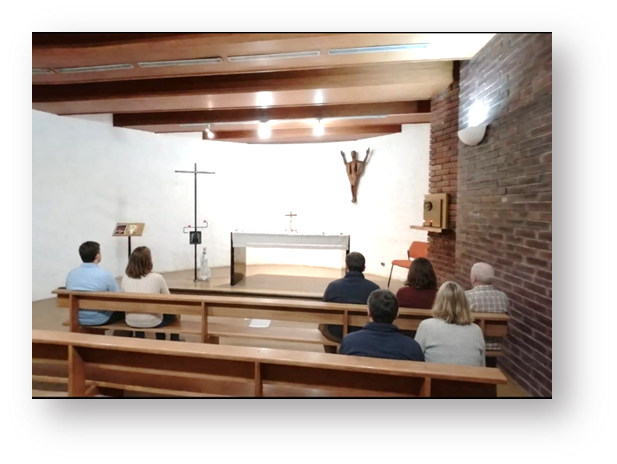
I would like to share a little more about this cohabitation in the Oratory. It is quite recent, since June 2025, that the Oratory has become this place of prayer shared equally, by all faiths.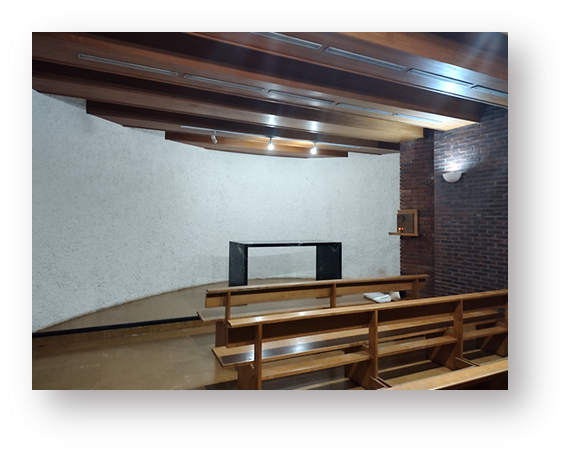
In dialogue with the Hospital Administration and our colleagues from other faiths, we sought ways to revitalize this place of prayer without disrupting the Hospital’s operations. The first step we took, was to request permission to open the Oratory for a specific time, on an ad hoc basis, to allow a patient who requested it to pray there, but only in our presence. This was granted. Subsequently, we obtained permission to open it for other celebrations beside mass, and on a regular basis. To achieve daily opening, we arranged with our colleagues from other faiths to ensure that there would be at least one prayer time in the Oratory every day. I experienced a truly beautiful communion between different religions. I am also deeply moved to see how much our colleagues rely on us, Catholic Chaplains, for these times of prayer that allow the Oratory to be open daily. It should be noted that we, Catholics, have the most hours of presence in the Henri Mondor Hospital.
Finally, the Direction decided to allow the Oratory to be open regularly, every day from 2 p. m. to 4 p. m., with free access for all who wish to pray. Now, one can sometimes find small groups praying together in the same Oratory, each according to their own religion. It is then possible to hear a decade of the Rosary to be murmured near the tabernacle, then in a corner a small group of Muslims praying together in hushed tones, and to see someone praying silently, siting simply on a bench, just as a Muslim gentleman once told me, who had come to thank me for finding a place to pray: ‘‘Isn’t right, Madam, the divine, is for everyone’’.
Nevertheless, the neutrality of the Oratory remains difficult for many Catholic Patients and Volunteers at the Hospital who remember the Chapel, now a multi-faith Oratory. My colleague and I organize ourselves to have a Catholic service every day, which allows us to reinstate the Cross, the Virgin Mary and Christ for at least half an hour each day. We have times of Adoration, the Rosary and the Stations of the Cross; and twice a week, we have the Eucharist or a Liturgy of the Word. Those who come to pray with us share their joy of seeing the Virgin Mary again or finding Christ welcoming us. Some are simply happy to know that there are people in the Hospital who pray for the sick.
We are not there yet, we dream of being able to open the Oratory for more than two hours a day.
Everything we do in the Hospital, visiting the sick, giving them the opportunity to receive the sacraments, listening to the families and loved ones of the sick, those who ask us to bless their deceased loved one before their final journey, praying for all the sick and those who care for them, we try to live according to this prayer, which has been the prayer of our Chaplaincy since long before we arrived here: ‘‘Lord Jesus, during your earthly life, You were the face of God’s tenderness among men. Now that you have made Yourself invisible, it is up to us, your disciples, to show your face of light. At the hour You are sending me to the sick, I address this prayer to You: dwell in me, Lord Jesus, efface me in you, make me transparent to your Presence and teach me to be the smile of your goodness; for, through me, it is you whom they can encounter deep within themselves. Inspire me constantly with the attitude to adopt, the words to speak and the silences to observe. Teach me to listen to them without interrupting. Help me to dare to hold their hand. Then, I will be for them a path that leads to You. Amen’’.